
Planetary consciousness without embodiment
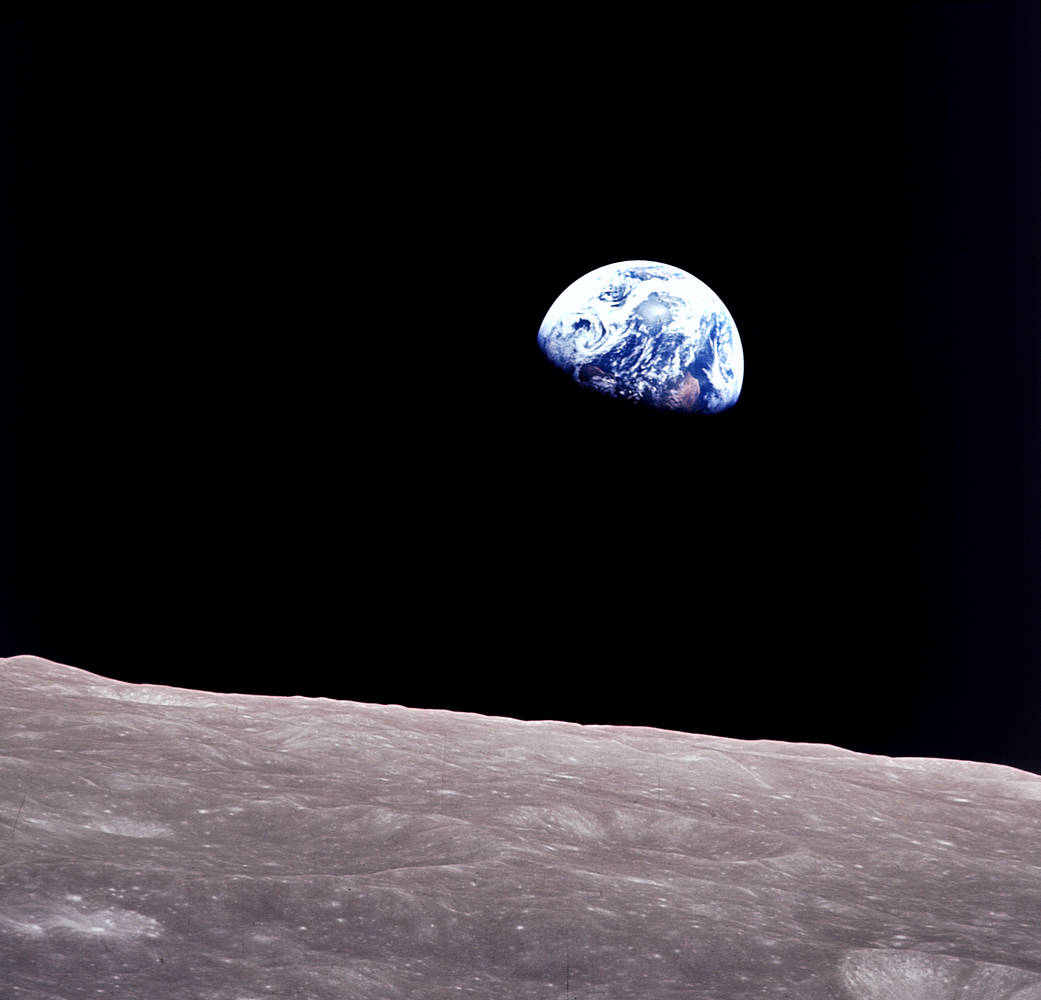
As I write, I think of the photograph now known as Earthrise,[1] taken by William Anders during Apollo 8 on 24 December 1968, as the first crewed spacecraft circumnavigated the Moon. The image has long been read academically as helping to catalyse environmental consciousness by presenting Earth as single, bounded, fragile, and shared; yet was this reading largely an academic aspiration rather than an embodied reality? As Thomas Simpson notes, whole-Earth photographs such as Earthrise and The Blue Marble were associated with hopes for a new “planetary consciousness” that “would prompt responsible recognition of human unity on a fragile common home.” At the same time, drawing on Benjamin Lazier, he notes that such images also became icons of competing commercial and environmental globalisms.[2] Read from the present, Earthrise can be understood as an image of conceptual distance: it offers the idea of planetary unity, fragility, and sharedness, yet does so from a position of separation, rendering Earth as a whole apprehended from afar rather than lived from within. In that sense, it becomes analogous to critical thinking itself. The concept is there, and so too is the expectation that conceptual achievement will lead to transformation; yet it does not necessarily translate into change at the scale or speed required. When Earthrise was taken, atmospheric carbon dioxide was around 323 ppm. It is now above 430 ppm.[3]
Whilst living through and responding to the destabilisation of our planetary home,[4] it is challenging to hold space for two demands at once: the critical reflection our moment requires, and the harder work of embodying that reflection in lived, material practice. Critical reflection remains vital. It helps catalyse the paradigm shifts desperately required to move beyond fossil fuel reliance, capitalist extraction, and entrenched inequalities in multispecies communities. It can also contribute to public discourse, institutional change, and policy formation. However, it is entirely possible to inhabit this conceptual terrain without making corresponding changes in one’s day-to-day, embodied relations, habits, and forms of labour.
The problem is not only intellectual inconsistency; it is structural. For many people working within academia, critical work is still carried out inside institutional systems increasingly shaped by marketisation, performativity, and neoliberal forms of governance. As Mark Olssen and Michael Peters argue, the traditional professional culture of open intellectual enquiry and debate has been replaced by an institutional stress on performativity, measured outputs, strategic planning, performance indicators, quality assurance measures, and academic audits. In this context, knowledge is increasingly reorganised through entrepreneurial and competitive logics, while academic labour is structured through targets, monitoring, accountability measures, and growing pressure on professional autonomy.[5]
This matters because the balance of labour is rarely in favour of lived transformation. The effort demanded by institutions often leaves diminished time, energy, and capacity for the work of reorienting everyday life, sustaining reciprocal relations, and acting within one’s multispecies community. This creates a painful contradiction: one may think and write critically about ecological collapse while remaining materially embedded in systems that reward extraction, speed, and abstraction. The question, then, is not only how to think otherwise, but how to live, work, and value differently within institutions still organised against that possibility.
Living ecologically within the problem
After several years of thinking, making, and writing within this contradiction, I found myself trying to address it not only conceptually but practically. I am neurodivergent, and there are growing reasons to think that neurodivergence may shape how some people perceive, feel, and relate to ecological change and to the more-than-human world. I became increasingly driven to untangle myself from capitalism wherever I could, and to adjust my life towards something lived more truthfully in relation with home, land, and kin. I was not attempting some impossible exit from the structures in which I remain implicated, but a different balance of attention, labour, and relation, one less fully organised by growth, output, and the demands of professional visibility.
Over the past two years, this has involved a difficult pivot away from what might conventionally be called professional practice and towards quieter modes of attention. Platforming and growth have slowly, and often painfully, given way to withdrawal from online platforms, distance from the treadmill of funding applications and delivery, and a refusal of the professionally and financially extractive studio model in which I had become enmeshed. Not only artistic labour, but the very systems required to sustain its production, were subject to continuous demand, while the margins for actual practice steadily diminished. Under such conditions, the labour of maintaining the structure increasingly threatened to overwhelm the labour of making within it.
In its place there is now pause, situated presence, and the beginnings of a listening, seeing, and learning practice on the land. I remain at a very early stage of relation, with much still to learn. The question behind the shift has been simple: if I can begin to embody entanglement within my own life and creative practice, rather than merely propose it, might I also begin to understand and articulate methods through which others might do so?
I emphasise the in-the-world dimension deliberately. Much of the response to ecological crisis within the environmental humanities, in which I partly locate myself, remains structurally theoretical. This is not a dismissal of such work, which is often vital, but a recognition of its limits when the forms of knowing through which it is produced remain largely disembodied. Academic life still tends to separate mind from body, reflection from practice, and knowledge from the material conditions of its own production. Even where interdisciplinarity begins to challenge that arrangement, it does so within institutional structures still governed by funding cycles, managerial pressure, internal politics, and limited collective capacity.[6] Ecological thought can therefore become highly sophisticated at the level of concept while making comparatively modest changes to the organisation of life.
Creative practice, by contrast, often begins elsewhere. It begins in embodied response, in the attempt to work something out through relation with place, matter, feeling, memory, atmosphere, and the pressures of lived experience. In that sense, art does not begin as a market act. It begins as a mode of attention, a way of exploring, testing, expressing, and trying to understand one’s place in the world. At its most vital, this process is not primarily driven by acquisition or extraction, but by curiosity, encounter, and the desire to widen perception. It is this that makes Timothy Morton’s claim that “all art is ecological” useful.[7] The point is not that every artwork is environmentally virtuous, or even that every artwork addresses ecological crisis explicitly, but that making already takes place within conditions of entanglement, dependence, coexistence, and more-than-human relation. Creative practice can therefore be understood as containing an ecological mode of knowing, even if that mode is later captured, constrained, or instrumentalised by the structures through which art circulates.
What begins in relation, however, does not remain untouched by capital. Artistic work is classified, priced, contextualised, collected, and made legible within systems of prestige, institution, and value. Artistic labour, like other forms of labour, is folded back into structures of accumulation. Art history has often facilitated this process, not simply by describing works after the fact, but by placing them into movements, categories, contexts, and hierarchies that sustain particular forms of significance and value. Ecological crisis places pressure on those inherited systems. If art is approached not primarily through the lenses of prestige, market value, and disciplinary inheritance, what other kinds of value might become visible? What forms of relation, dependence, reciprocity, or more-than-human entanglement might come into view?
It is from within this tension that I return to academia after a decade away. I do so cautiously, and with the hope that I might enter it differently: not to abandon the slow relational work I have begun, but to test whether it can be carried into an institutional setting without being entirely stripped of its force.
I find myself, somewhat unexpectedly, in an art history department, following conversations with ecocritical art historians who pointed me towards Olga Smith and Andrew Patrizio’s Methods for Ecocritical Art History.[8] Can one participate ecologically within existing disciplinary structures and alter them from within, or do such structures remain too bound to older habits of abstraction, categorisation, and value? What interests me in this work, is not only whether art history can become more responsive to ecological crisis as a field of interpretation, but whether its methods might begin to shift the forms of value, relation, and attention that matter beyond the page.
‘Methods for Ecocritical Art History’
Smith and Patrizio present an urgent methodological intervention in a time of ecological crisis. Ecocriticism is not framed as a minor thematic addition to art history’s existing repertoire, but as a necessary reorientation of the discipline itself. The introduction makes this ambition clear from the outset. Ecocritical art history is presented not simply as a way of identifying environmental subject matter in artworks, but as a mode of inquiry capable of revealing the interdependencies between human and more-than-human worlds, and of bringing those interconnections into sharper interpretive focus. The book has something of the force of a manifesto, even if it presents as a methods proposal.
The editors are not arguing that art history should occasionally attend to ecological crisis when obviously relevant. They are making the stronger claim that ecological methods are now indispensable to the discipline. This is partly because ecological crisis alters the historical conditions within which all cultural production must now be read. However, it is also because, as they insist, art history itself has long been organised through categories, habits of thought, and institutional priorities that are no longer adequate to the world it seeks to describe. Their project is therefore both corrective and propositional. It asks what ecocritical art history has already become, and what it still needs in order to act more fully within and beyond the discipline.
The volume also operates in two modes at once. On the one hand, its sectional structure, methodological framing, and explicit concern with how ecocritical art history might be practised make it useful for teaching. It offers scaffolding for course design, for introducing students to a field still consolidating its terms, and for organising discussion around key methodological themes. On the other hand, the individual essays are not written primarily as pedagogic summaries. They are peer-to-peer scholarly interventions, pitched at researchers and advanced readers already working within art history, environmental humanities, and adjacent debates. Yet they also serve as examples of method in practice: not simply describing what ecocritical art history is, but showing how it can be done. The book is therefore useful not because it simplifies the field, but because it holds open a space between instruction and scholarly argument.
One of the most significant shifts is away from earlier ecocritical attention to recognisably environmental subjects such as landscape, land art, and activism, towards a broader proposition that ecology may be understood as constitutive of artistic practice itself. Their embrace of Timothy Morton’s assertion that “all art is ecological” matters in this regard. It moves ecocriticism away from being reserved for overtly environmental art, and towards a more expansive mode of inquiry capable of identifying interdependence, material relation, and more-than-human entanglement wherever they are at work. This challenges inherited systems of value in art history and asks what becomes visible when relation, dependence, and ecological embeddedness are foregrounded.
Just as important is the editors’ insistence on method rather than theory. Throughout the introduction they distinguish ecocritical method from a merely speculative or explanatory framework. Method, in their account, is practical and action-oriented. It concerns how one proceeds, what one notices, what one places in relation, and what kinds of interpretive action become possible. Ecocritical art history is therefore not merely another lens to add to the disciplinary toolbox, but an attempt to alter the discipline’s procedures of attention from within.
At the same time, what becomes apparent across the six proposed methods is that they do not wholly begin from scratch. Rather than discarding art history’s inherited organising structures, it largely takes familiar disciplinary categories and subjects them to ecological revision. ‘Space’ begins with the long-standing art-historical importance of place, geography, and region, but widens into questions of planetarity, ecological commons, colonial violence, and Indigenous relation to land. ‘Time’ moves beyond chronology and periodisation, into geological, climatic, and more-than-human temporalities. ‘Bodies’ extends feminist and queer methods within art history into questions of ecological embodiment, fluidity, sexuality, and porous relationality. ‘Matter’ reworks the traditional concern with medium and materiality into a broader account of active matter, extraction, toxicity, infrastructure, and world formation. ‘Beings’ challenges the assumption that animals, plants, and other life forms enter art history merely as symbols or motifs for human concerns, instead moving towards multispecies methods attentive to nonhuman agency and relation. ‘Communities’, finally, places decolonial and Indigenous frameworks at the centre, raising direct questions about the adequacy of Western art history’s own foundations.
The methods are not uniform in origin or effect; some ecologically revise foundational art-historical categories, others extend later critical methods already internal to the discipline. Importantly, the volume does not offer a clean replacement of traditional method with a wholly new ecological structure. What it offers instead is something more transitional, and more uneven: a discipline trying to transform itself through the categories it has inherited, even as those categories are shown to be historically compromised.
This itself, feels like a compromise. Art history’s traditional structures of place, period, object, medium, and cultural value were formed within Western classificatory reason, within museum and imperial histories, within colonial geographies, and within systems that helped stabilise ownership, hierarchy, and distinction. Smith and Patrizio are clearly aware of this, particularly in their treatment of nationalism, colonialism, decolonisation, and Indigenous methodologies. Yet the question remains whether inherited structures can be ecologised from within sufficiently, or whether some of them are too deeply shaped by extractive and colonial epistemologies to bear the weight of ecological reorientation without more fundamental reconstruction.
This is not a criticism of the project’s seriousness. On the contrary, one of the volume’s strengths is its willingness to name the field’s unresolved problems (organisation, professional legitimacy, methodological distinctiveness, and significance beyond the academy), while remaining attentive to positionality, collaboration, and self-reflexive academic practice. What it reminds me of, materially and methodologically, is an insight from research on how innovations diffuse: novel practices are adopted more readily when they are compatible with existing values, past experience, and crucially, existing routines and requirements. Changes that demand a wholesale retooling of established practice face much greater inertia.
In that light, the book’s insistence on working through recognisable methods is not conservative so much as strategic: it increases the chances of uptake by arriving in forms the discipline already knows how to handle. It does not offer a finished ecological method, but a serious and necessary attempt to move the discipline towards one. It makes the tensions visible: between theory and method, disciplinary inheritance and ecological transformation, interpretation and action, revision and reconstruction.
If ecocritical art history seeks to reveal reciprocity, dependence, plurality, and more-than-human relation, can a discipline formed through separation, categorisation, and abstraction be transformed simply by revising its existing methods, or does an ecological way of knowing require a more radical reorganisation of the discipline itself?
Chapter reading: Weathering Art History: Metaphor and Method – Mark Cheetham
Cheetham’s chapter sits within the book’s section on time, yet it approaches temporality obliquely, through weather. Weather is one of the ways time is lived rather than merely measured. It is cyclical, eventful, unstable, seasonal, durational, and intimately bodily (I write this as intense rainfall passes across the landscape, troubling livestock, overwhelming watercourses, and sending thunder around the glen). Weather exceeds the linearity of periodisation; it connects us polytemporally, reminding us that life has always unfolded within atmospheric conditions that are neither backdrop nor metaphor alone. In that sense, a chapter on ‘weathering’ belongs within a section on time because weather is one of the experiential conditions through which time becomes palpable, and through which temporal difference is registered in bodies, materials, and worlds. If the chapter seeks to think through weather as a way of unsettling conventional art-historical time, however, what exactly is weather here, and what remains of its specificity once it is drawn into ecocritical method?
In meteorological terms, weather is not simply atmosphere in a loose figurative sense, but the short-term state and behaviour of the atmosphere itself. It is constituted by temperature, pressure, moisture, wind, cloud, circulation, and precipitation, always locally expressed but globally conditioned. NOAA defines weather as the state of the atmosphere at a given point in time and place, while the distinction between weather and climate depends fundamentally on timescale.[9] Weather is immediate and variable; climate is the statistical pattern of weather over longer durations. To begin with weather, then, is not to begin with a free-floating image of flux or exposure, but with a materially specific, time-situated process.
This matters because, after opening with weather as an “increasingly significant thematic preoccupation in art history and visual studies”,[10] Cheetham moves very quickly into Astrida Neimanis and Rachel Loewen Walker’s “Weathering: Climate Change and the ‘Thick Time’ of Transcorporeality”,[11] where the term is doing rather different work. In ecological and earth-science terms, ‘weathering’ refers to the physical, chemical, and biological alteration of matter through exposure to weather over time. The British Geological Survey defines weathering as the “wearing down or breaking of rocks while they remain in place”.[12] Neimanis and Walker’s paper, by contrast, reworks weathering as a feminist new materialist concept. They describe it as “a logic, a way of being/becoming, or a mode of affecting and differentiating that brings humans into relation with more-than-human weather,” and as “the intra-active process of a mutual becoming” through which humans and climate change come to matter. In this context, “weathering” names embodied implication in climate change, folded across past, present, and future, rather than atmospheric process as such.
From there, through Cheetham, the term extends further into the institutional, curricular, and labour conditions of the discipline itself. What emerges, then, is not one expanded meaning but several distinct uses held together under a single heading: weather as atmospheric condition, weathering as geological process, weathering as feminist philosophical concept, and weathering as a model for disciplinary and pedagogic transformation. These may well be connected, but they are not identical. Cheetham is not using weathering only to describe artworks or modes of attention. He explicitly adapts it to institutional contexts, asking how an ecocritical art history might work within departments, curricula, exhibitions, and teaching. His reflections on redesigning an introductory art history course make clear that ‘weathering’, in his hands, is meant to become practical. It names a shift in emphasis, a reorientation of disciplinary priorities, and a willingness to make art history more responsive to meteorological and planetary phenomena. In that sense, weathering becomes both metaphor and method.
My uncertainty is not that such movement is illegitimate, but that the chapter does not always pause long enough over what kind of change is being proposed. If ecocritical method seeks to become ecological in more than name, then the question is not only whether weathering can stand for change, but whether the term remains answerable to the specificity of the process it borrows. In geological terms, weathering is not a general synonym for alteration. It names the in-situ breakdown and transformation of matter through physical, chemical, and biological exposure over time. To weather a discipline, if one were to take that process seriously, might therefore mean more than revising its themes or broadening its frames. It might mean exposing its hardened categories to sustained abrasion, allowing inherited structures to decompose, inviting infiltration from outside their old boundaries, and accepting uneven material transformation rather than mere conceptual adjustment. Cheetham moves in this direction but does not fully articulate it. What he offers is less a process-specific account of disciplinary weathering than a persuasive call for disciplinary reorientation under the sign of weather; ‘I am suggesting nothing more – or less – than a change in emphasis and perspective’.[13]
The chapter turns to the nineteenth-century examples of the inventor Merryweather and artist J. M. W. Turner. Here weather is not only a travelling metaphor but part of a specific historical field of observation, sensation, prediction, and representation. Weather is attached to nineteenth-century meteorological curiosity, instrumentality, and atmospheric experience. That grounding gives the chapter greater historical density. It is no longer simply claiming that weather can be philosophically generative, but showing how weather has been known, represented, and lived within particular historical conditions. It also demonstrates that, through ‘weathering the discipline’, two works are brought into conversation that would not ordinarily be associated, making visible the kinds of unexpected relation that an ecocritical method might enable.
By the end of the chapter, Cheetham’s ambition is clear. He does not want only an art history attentive to weather as theme. He seems to want an art history itself weathered: in Neimanis and Walker’s terms, exposed to forces and flows, altered by entanglement, unable to imagine itself as standing outside the conditions it studies.[14] This aligns with the book’s wider attempt to make the discipline more responsive to ecological interdependence. But if weathering is to be more than a rich humanities metaphor, then the relation between atmospheric process, geological alteration, philosophical transposition, and disciplinary change needs to be made more explicit. Otherwise, weather risks becoming a source of conceptual vocabulary (process, exposure, relation, entanglement), while its own material specificity drops away.
There is a difference between thinking with weather and translating weather into a general philosophical language. The former might require attention to what weather actually is: relational, multiscalar, unstable, emergent from interacting variables, locally expressed but globally conditioned, and always bound to material processes of atmosphere, moisture, pressure, movement, and time. The latter may still be conceptually fertile, but it is no longer clearly answerable to the weather-ness of weather. If ecocritical art history seeks not only to speak ecologically but to become ecological in its own procedures, then mirroring ecological processes might demand more than the migration of ecological terms into humanities discourse. It might require remaining accountable to the knowledges, scales, and material behaviours of the processes being invoked.
Cheetham’s chapter is valuable to me precisely because it does not settle these questions. It reveals both the promise and the risk of interdisciplinary method. On the one hand, it opens art history to a richer sense of exposure, duration, entanglement, and temporal thickness. On the other, it shows how easily a discipline can borrow from ecology without fully submitting itself to ecological specificity. A more fertile exercise might involve deeper collaboration with a meteorologist, alongside the kind of embodied transformation that Neimanis and Walker propose. What is finally at stake here is not only the meaning of weather, but the question of how time itself is being rethought: as period, as event, as exposure, or as duration lived through matter.
Beyond the academy
My question, finally, is what these methods might do outside the university. As Cheetham suggests, at their strongest, they can alter the terms of cultural value.[15] They can change what institutions notice, what they commission, conserve, interpret, and teach, and how publics are invited to understand the relations between art, matter, history, and more-than-human life. In that sense, ecocritical method may travel beyond academic discourse, not because it produces better readings alone, but because it can begin to shift the grounds on which artworks are legitimised, displayed, and valued. If art history learns to foreground extraction, interdependence, repair, situatedness, and ecological consequence, then museums, galleries, collections, and public programmes may also begin to orient themselves differently.
Yet this is also where a further difficulty arises. Oliver Cussen, writing recently in the London Review of Books on history after climate change, draws out a problem that feels directly relevant here.[16] He notes Dipesh Chakrabarty’s long-standing argument that anthropogenic climate change unsettles inherited assumptions about agency, experience, and causation, but he also insists that climate history cannot stop at planetary abstraction, because modern freedoms, democracy, decolonisation, and development remain materially bound to fossil fuel use, fertiliser consumption, air travel, motor vehicles, and industrial agriculture. The problem, in other words, is not only that climate forces us beyond a narrowly human frame, but that such enlargement can also blur responsibility if the concrete agents and infrastructures of extraction disappear from view.
This seems to me an important warning for ecocritical method more broadly. To widen the frame to include entanglement, transcorporeality, more-than-human relation, or planetary process is necessary. But if, in doing so, one extracts the human and the institutions of capital from the reading, culpability is softened rather than clarified. The result can be curiously weightless: everything is connected, but no one remains answerable. That is one reason my concerns about Cheetham’s weathering chapter matter beyond that chapter alone. If weather becomes a general philosophical language of process, exposure, and relation, and if ‘climate’ can slide from atmosphere to institutional mood to labour negotiation without the shift being sufficiently marked, then ecocritical method risks becoming conceptually rich precisely where it becomes politically thin.
The same risk applies, perhaps even more sharply, once such methods enter the art world beyond the academy. Capital is highly adept at absorbing critique.[17] It does not need to reject ecological discourse in order to neutralise it; it can incorporate it. Terms such as care, entanglement, repair, sustainability, and more-than-human relation can all be converted into new forms of prestige, distinction, and market legitimacy. Ecological discourse can become a premium language, a way of refreshing cultural seriousness without changing the structures through which value is produced and protected. In that sense, ecocritical method may do real interpretive work while still being assimilated to an existing framework, adding value rather than redistributing it.
This matters especially for existing collections and institutional infrastructures. A collection does not cease to be financially valuable because it is re-read ecologically; indeed, such a re-reading may increase its relevance, exhibition potential, and discursive capital. Labels can be rewritten, themes updated, programmes expanded, while the underlying structures of ownership, sponsorship, transport, insurance, storage, labour, and property remain materially untouched. At that point, ecocritical art history would be extending the interpretive life of the collection without necessarily unsettling the extractive world in which that collection is maintained. What appears as transformation at the level of discourse may amount, in practice, to value-added interpretation.
And yet this does not mean the methods are useless outside the academy. It means that their extra-academic force depends on whether they remain interpretive or begin to inform decisions. Can they alter acquisition priorities, curatorial criteria, commissioning structures, institutional relationships to land and materials, funding models, conservation ethics, and the infrastructures of display? Can they change what kinds of work are supported, and on what grounds? Can they pressure the assumptions through which prestige, rarity, and investment continue to dominate the valuation of art? If not, then ecology becomes one more sophisticated moral language through which art’s existing hierarchies are renewed. If so, however, then ecocritical method might begin to pressure not only interpretation but the political economy of culture itself.
This returns me, finally, to the contradiction with which I began. The problem is not only how to think ecologically, but how not to leave ecological thought at the level of concept. Earthrise offered the image of planetary unity and fragility, apprehended from afar. The concept was there; the transformation was expected to follow. It did not. The danger for ecocritical art history is similar. It may generate better concepts, richer methods, subtler forms of relation, while still being absorbed by institutions organised around extraction, prestige, and accumulation. Its challenge, beyond the academy, is therefore not simply to widen the frame, but to resist assimilation, to remain answerable both to ecological specificity and to historical culpability, and to ask what changes when a method enters material life rather than remaining on the page.
Acknowledgement
My thanks to Chris Fremantle for generous critical feedback, editorial guidance, and conversation that helped shape this essay in its later stages.
[1] NASA, Apollo 8: Earthrise, 23 December 2020 <https://www.nasa.gov/image-article/apollo-8-earthrise/> [accessed 30 June 2026].
[2] Thomas Simpson, ‘Planetary Pictures: Historicizing Environmental and Climate Sciences in the Anthropocene’, BJHS Themes, 9 (2024), pp. 83–102, doi:10.1017/bjt.2024.1.
[3] Robert Monroe, ‘The Keeling Curve’, The Keeling Curve, n.d. <https://keelingcurve.ucsd.edu> [accessed 1 July 2026].
[4] Katherine Richardson and others, ‘Earth beyond Six of Nine Planetary Boundaries’, Science Advances, 9.37 (2023), p. eadh2458, doi:10.1126/sciadv.adh2458.
[5] Mark Olssen and Michael A. Peters, ‘Neoliberalism, Higher Education and the Knowledge Economy: From the Free Market to Knowledge Capitalism’, Journal of Education Policy, 20.3 (2005), pp. 313–45, doi:10.1080/02680930500108718.
[6] Charlotte Sleigh, Sarah Craske, and Simon Park, ‘Lowering the Tone in Art and Science Collaboration: An Analysis from Science and Technology Studies’, Journal of Science & Popular Culture, 2.1 (2019), pp. 37–51, doi:10.1386/jspc.2.1.37_1.
[7] Timothy Morton, All Art Is Ecological, Green Ideas, 3, This extract published in Penguin Books (Penguin Books, 2021).
[8] Methods for Ecocritical Art History, ed. by Olga Smith and Andrew Patrizio (Manchester University Press, 2026).
[9] ‘Weather and Atmosphere | National Oceanic and Atmospheric Administration’, n.d. <https://www.noaa.gov/education/resource-collections/weather-atmosphere> [accessed 1 July 2026].
[10] Smith and Patrizio, Methods for Ecocritical Art History.
[11] Astrida Neimanis and Rachel Loewen Walker, ‘Weathering: Climate Change and the “Thick Time” of Transcorporeality’, Hypatia, 29 (2013), doi:10.1111/hypa.12064.
[12] ‘Weathering’, British Geological Survey, n.d. <https://www.bgs.ac.uk/discovering-geology/geological-processes/weathering/> [accessed 1 July 2026].
[13] Smith and Patrizio, Methods for Ecocritical Art History.
[14] Neimanis and Loewen Walker, ‘Weathering’.
[15] Smith and Patrizio, Methods for Ecocritical Art History.
[16] Oliver Cussen, ‘No One Can Live on Iron’, review of Sunil Amrith, The Burning Earth: An Environmental History of the Last Five Hundred Years, History & Classics, London Review of Books, 48.08 (2026) <https://www.lrb.co.uk/the-paper/v48/n08/oliver-cussen/no-one-can-live-on-iron> [accessed 1 July 2026].
[17] Luc Boltanski, Eve Chiapello, and Gregory Elliott, The New Spirit of Capitalism, New updated edition (Verso, 2018).


Leave a Reply