About
ecoartscotland is:
- a new resource focused on art and ecology for artists, curators, critics, commissioners as well as scientists and policy makers.
- it is ecoartscotland papers [ISSN 2043-8052] which will comprise of a mix of discussions of works by artists and critical theoretical texts. Published occasionally, we aim to have 6-8 significant essays per year/issue. Articles should be submitted to ecoartscotland (see terms and conditions).
- ecoartscotland is a curatorial platform.
It has been established by Chris Fremantle, producer and research associate with On The Edge Research, Gray’s School of Art, The Robert Gordon University. Fremantle is a member of a number of international networks of artists, curators and others focused on art and ecology. He has worked with some of the eminent practitioners in the field including Helen Mayer Harrison, Newton Harrison and David Haley on Greenhouse Britain: Losing Ground, Gaining Wisdom (2006-2008) and with PLATFORM on Remember Saro-Wiwa. He has published on the subject and is co-author of the AHRC funded research report The Artist as Leader (2009).
Contact
chris at fremantle dot org or http://chris.fremantle.org.
Lots of things have an ‘eco’ prefix: corporate culture has recognised the value of green and politicians have climbed on the bandwagon. But underlying these issues are the deep dependencies of western culture on the extraction of resources mostly from places that are ‘off the radar’ (whether that is Douglas in South Lanarkshire or the Niger Delta) and economies dependent on growth.
Although the largely unquestioned extraction of resources continues, there are some indications of a turning point. Nicholas Bourriaud, the curator, dated the end of modernism (the ultimate project of progress built on the assumption of limitless energy) to the oil crisis of 1973 (2008). We might equally point to the Archimedean moment following the Apollo Mission when we were first able to see ourselves from space. One of the recurring concerns in the making of art has been the representation of the human relationship with the world (and that image of the Earth in space, though not made by an artist, is one of the really important ones). What is the relationship of human beings to the world and does art have a role in questioning this relationship?
Ecology (according to Wikipedia) is the interdisciplinary scientific study of the interactions between organisms and their environments. This can position the social, political and technological alongside the biological, chemical and physical.
Some artists are equally interested in the interdisciplinary and the relationship between people and their environments. Artists are not simply illustrators or communicators for the sciences. Nor are they the decorators of social spaces or the people who bring creativity to the classroom. The most interesting are agents for change.
But the meeting of art and ecology, sometimes called ecoart, is not just a meeting of shared interests in the science. Other issues are enmeshed in this, including that of the everyday, a key theme in 19th and 20th century art. De Certeau (1985, p.17), the philosopher of the everyday, in his essay for the catalogue of Helen Mayer Harrison and Newton Harrison’s seminal work Lagoon Cycle, says,
“Art is what attention makes with nature.”
There are both scientists and artists concerned with everything from micro-organisms in soil to the dynamics of bioregions. Scientists are interested in generating testable theories: they speak in terms of probability. Artists are more specifically focused on meaning. When these two concerns collaborate there are very interesting results. Some artists working with nature are widely recognised such as Andy Goldsworthy, as are some of the landscape/architects such as Charles Jencks. However the diversity of practices is far greater. Artists interested in ecology are are often seeking to reconnect these apparently different territories (social, political, technological with the environmental) and engage communities in ways to improve environments. Some work in this field specifically invites action on the part of people experiencing the work: to take some aspect of the art into their everyday lives, as a new understanding, or as a different way of living.
In a piece I recently published, I highlighted a range of positions apparently taken by artists between making art which is overtly useful and making art which is ironic or primarily critical of the way things are done in the world. An example of work that is critical without being utilitarian is Simon Starling’s Island with Weeds – Prototype (2003) intended to float on Loch Lomond as a safe place for Rhododendrons.
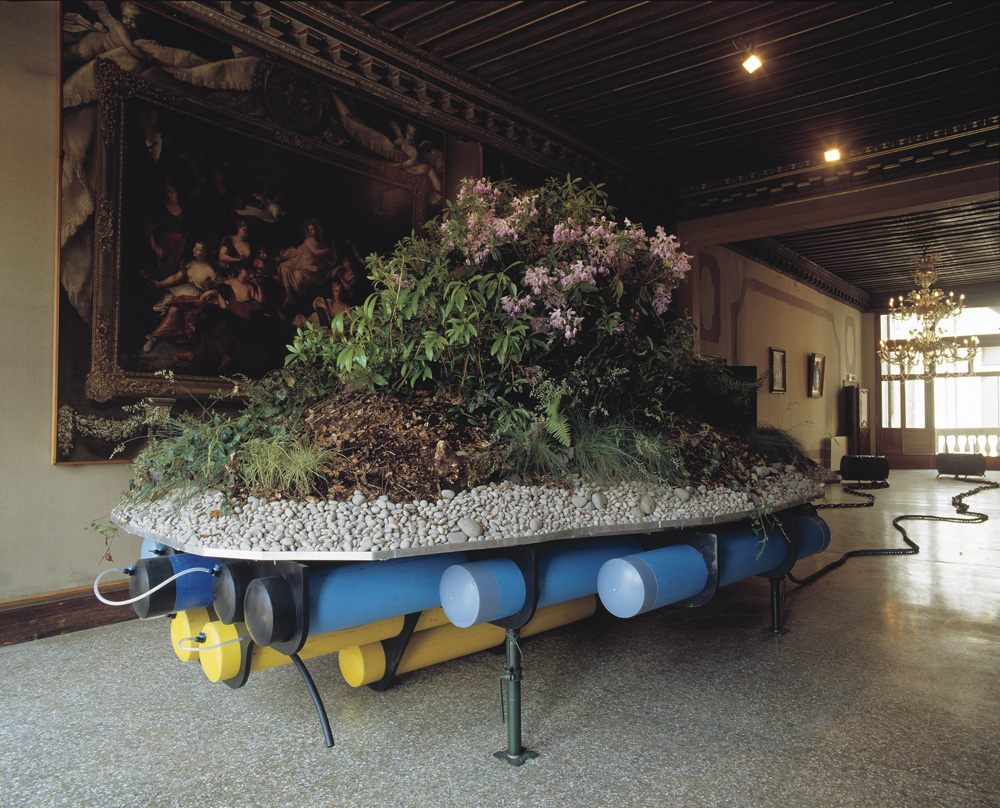
Simon Starling, Island for Weeds - Prototype (2003) seen at the Venice Biennale as part of Scotland's Pavilion entitled Zenomap
This work raises challenging questions about the idea of naturalness. Contrasted with this would be Helen Mayer Harrison and Newton Harrison’s Survival Piece #6: Full Farm (1974).
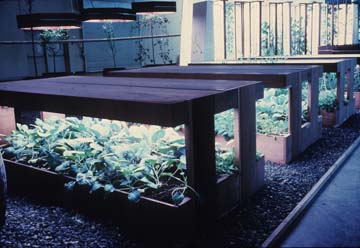
This work, comprising a number of earth filled boxes planted with a variety of vegetables and a fluorescent lighting system, was intended as an educational tool, teaching museum staff, visitors and school children the potential for urban farming. The Harrisons described their intention that all their works contribute to eco-systemic wellbeing, and have gone on to make work addressing bioregions which have influenced public policy. Mark Dion’s Wilderness Unit (2006) comments on the commercialisation of nature by placing a diorama of a wolf on a trailer: nature represented for convenient and mobile consumption.
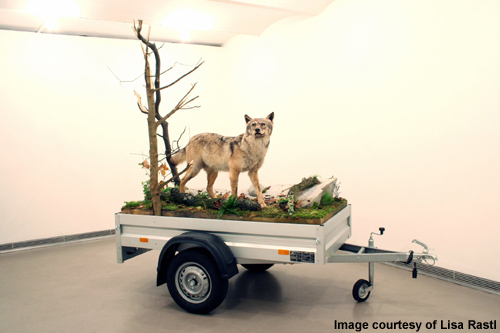
Mark Dion, Wilderness Unit, (2006) included in the Barbican Show but unfortunately not in the East Ayrshire show
This might be contrasted with Mierle Laderman Ukeles who has spent the last quarter century working with the New York City Sanitation Department drawing attention to waste. Her two year performance, Touch Sanitation, involved shaking hands with all of the 8,500 employees of the Department and saying to each of them “Thank you for keeping New York City alive.” (For more information on Ukeles project see the essay by Morgan in the Reading Room at communityarts.net)
One of the complex issues for artists working in this field is that of the gallery (or other art space). Smithson’s idea of site and non-site, between the space of the abstract representation and the lived reality, is helpful to understand the art that we might see in different locations, whether that is at a landfill site or in a gallery (see Flam, 1996). Smithson is usually associated with the Land Art movement (and this does not always sit comfortably with artists interested in ecology), but his works and writings reveal an interest in the relationship between human beings and their environments that is very provocative.
Work in the field of art and ecology has an ethical dimension, raising fundamental questions about value. PLATFORM‘s work Funding for a Change directly addressed the ethical dilemmas of corporate sponsorship. For some artists working in this field the spiritual is also an important dimension which needs to be reintroduced into everyday life. There is danger that this becomes another form of objectification, where the natural is pure or spiritual and separate from the human. Alistair McIntosh’s book Soil and Soul: People Versus Corporate Power (2001) makes a compelling case for the spiritual dimension without being ‘new age’.
The genre of art and ecology has produced some outstanding works of art by any standards. It has also produced some works of art which have had a significant influence on our understanding of our relationship with our environment (the world). For further reading on what ecoart might be see Beth Carruthers’ Mapping the Terrain of Contemporary Eco-ART Practice and Collaboration, a research report commissioned by the Canadian Commission for UNESCO for Arts in Ecology – A Think-Tank on Arts and Sustainability. Published online by UNESCO. 2006. Also the website for Ann T Rosenthal’s course on environmental art provides a good introduction.


February 10, 2011 at 10:16 pm |
[...] ecoartscotland is a resource focused on art and ecology for artists, curators, critics, commissioners as well as scientists and policy makers. It includes ecoartscotland papers, a mix of discussions of works by artists and critical theoretical texts, and serves as a curatorial platform. [...]
February 10, 2011 at 11:34 pm |
[...] ecoartscotland is a resource focused on art and ecology for artists, curators, critics, commissioners as well as scientists and policy makers. It includes ecoartscotland papers, a mix of discussions of works by artists and critical theoretical texts, and serves as a curatorial platform. [...]
February 17, 2011 at 1:10 am |
[...] are on the IASH website at http://www.iash.ed.ac.uk/projects.html ecoartscotland is a resource focused on art and ecology for artists, curators, critics, commissioners as well as [...]
February 19, 2011 at 2:30 pm |
[...] breaks up virtuous cycles of knowledge and action in favour of prioritisation for funding purposes. ecoartscotland is a resource focused on art and ecology for artists, curators, critics, commissioners as well as [...]
February 23, 2011 at 3:08 pm |
[...] World Development Movement for these links. Please add comments with other links and information. ecoartscotland is a resource focused on art and ecology for artists, curators, critics, commissioners as well as [...]
February 25, 2011 at 4:08 am |
[...] ecoartscotland is a resource focused on art and ecology for artists, curators, critics, commissioners as well as scientists and policy makers. It includes ecoartscotland papers, a mix of discussions of works by artists and critical theoretical texts, and serves as a curatorial platform. [...]
February 26, 2011 at 4:08 am |
[...] so I did contribute. Art may belong to a ‘gift’ culture, but where does the gift come from? ecoartscotland is a resource focused on art and ecology for artists, curators, critics, commissioners as well as [...]
March 7, 2011 at 1:34 am |
[...] Finance Campaigner for Friends of the Earth Scotland, and an MSc student in Ecological Economics. ecoartscotland is a resource focused on art and ecology for artists, curators, critics, commissioners as well as [...]
March 7, 2011 at 3:37 am |
[...] Finance Campaigner for Friends of the Earth Scotland, and an MSc student in Ecological Economics. ecoartscotland is a resource focused on art and ecology for artists, curators, critics, commissioners as well as [...]
March 10, 2011 at 6:33 pm |
[...] artforms. The question in the end is whether this is didactic or whether it opens up dialogue. ecoartscotland is a resource focused on art and ecology for artists, curators, critics, commissioners as well as [...]
March 11, 2011 at 6:34 pm |
[...] ecoartscotland is a resource focused on art and ecology for artists, curators, critics, commissioners as well as scientists and policy makers. It includes ecoartscotland papers, a mix of discussions of works by artists and critical theoretical texts, and serves as a curatorial platform. [...]
March 28, 2011 at 4:34 pm |
[...] Ian Hamilton Finlay), as well as the issues of sustainability (Eduardo Rabel’s mural project). ecoartscotland is a resource focused on art and ecology for artists, curators, critics, commissioners as well as [...]
March 30, 2011 at 4:07 pm |
[...] justice raising questions of responsibility for the desolation of the Niger Delta, etc. ecoartscotland is a resource focused on art and ecology for artists, curators, critics, commissioners as well as [...]
March 30, 2011 at 5:08 pm |
[...] justice raising questions of responsibility for the desolation of the Niger Delta, etc. ecoartscotland is a resource focused on art and ecology for artists, curators, critics, commissioners as well as [...]
April 13, 2011 at 3:19 am |
[...] ecoartscotland is a resource focused on art and ecology for artists, curators, critics, commissioners as well as [...]
April 13, 2011 at 3:18 pm |
[...] ecoartscotland is a resource focused on art and ecology for artists, curators, critics, commissioners as well as [...]
April 15, 2011 at 3:19 am |
[...] there is an excellent pdf download of info which is embedded into the artwork in the exhibition. ecoartscotland is a resource focused on art and ecology for artists, curators, critics, commissioners as well as [...]
April 20, 2011 at 5:00 am |
[...] also worth looking at Greenspace Scotland for policy and practice on ‘stalled spaces.’ ecoartscotland is a resource focused on art and ecology for artists, curators, critics, commissioners as well as [...]
April 20, 2011 at 4:29 pm |
[...] and Sounds of Bitumen Extraction in Alberta Canada provides a deep exploration of a locality. ecoartscotland is a resource focused on art and ecology for artists, curators, critics, commissioners as well as [...]
May 1, 2011 at 2:50 am |
[...] ecoartscotland is a resource focused on art and ecology for artists, curators, critics, commissioners as well as [...]
May 1, 2011 at 4:00 am |
[...] ecoartscotland is a resource focused on art and ecology for artists, curators, critics, commissioners as well as [...]
May 1, 2011 at 5:38 pm |
[...] while drawing from the deep roots of art history and the broadest lexicon of aesthetic methods. ecoartscotland is a resource focused on art and ecology for artists, curators, critics, commissioners as well as [...]
May 2, 2011 at 2:48 am |
[...] subsumed into the artists, who use it for their own pleasure and what they take to be its good.” ecoartscotland is a resource focused on art and ecology for artists, curators, critics, commissioners as well as [...]
May 2, 2011 at 3:18 am |
[...] subsumed into the artists, who use it for their own pleasure and what they take to be its good.” ecoartscotland is a resource focused on art and ecology for artists, curators, critics, commissioners as well as [...]
May 3, 2011 at 4:00 am |
[...] ecoartscotland is a resource focused on art and ecology for artists, curators, critics, commissioners as well as [...]
May 4, 2011 at 5:51 pm |
[...] ecoartscotland is a resource focused on art and ecology for artists, curators, critics, commissioners as well as scientists and policy makers. It includes ecoartscotland papers, a mix of discussions of works by artists and critical theoretical texts, and serves as a curatorial platform. [...]
May 12, 2011 at 3:40 pm |
[...] ecoartscotland is a resource focused on art and ecology for artists, curators, critics, commissioners as well as [...]
May 12, 2011 at 4:00 pm |
[...] ecoartscotland is a resource focused on art and ecology for artists, curators, critics, commissioners as well as [...]
May 14, 2011 at 4:45 am |
[...] people” meaning to be strong in the western culture, and also strong in the traditional culture. ecoartscotland is a resource focused on art and ecology for artists, curators, critics, commissioners as well as [...]
June 6, 2011 at 8:24 pm |
[...] to appropriate these technologies, and the form of appropriation must manifest the critique. ecoartscotland is a resource focused on art and ecology for artists, curators, critics, commissioners as well as [...]
June 7, 2011 at 7:00 pm |
[...] as well as Arts Catalyst‘s recent project on research stations in the Arctic, amongst others. ecoartscotland is a resource focused on art and ecology for artists, curators, critics, commissioners as well as [...]
June 8, 2011 at 8:24 pm |
[...] ecoartscotland is a resource focused on art and ecology for artists, curators, critics, commissioners as well as [...]
June 11, 2011 at 9:03 pm |
[...] information can bee found at http://bioartsociety.fi ecoartscotland is a resource focused on art and ecology for artists, curators, critics, commissioners as well as [...]
June 12, 2011 at 9:03 pm |
[...] there is still space available. More info here: http://www.ecuad.ca/programs/courses/CESE/355/SU01 ecoartscotland is a resource focused on art and ecology for artists, curators, critics, commissioners as well as [...]
June 14, 2011 at 12:50 pm |
[...] ecoartscotland is a resource focused on art and ecology for artists, curators, critics, commissioners as well as [...]
June 15, 2011 at 1:45 pm |
[...] coming up in the Autumn focusing on Conflict Management and Resolution, all interesting stuff. ecoartscotland is a resource focused on art and ecology for artists, curators, critics, commissioners as well as [...]
July 19, 2011 at 1:00 am |
[...] ecoartscotland is a resource focused on art and ecology for artists, curators, critics, commissioners as well as scientists and policy makers. It includes ecoartscotland papers, a mix of discussions of works by artists and critical theoretical texts, and serves as a curatorial platform. [...]
July 19, 2011 at 8:49 pm |
[...] by two masters, barely touches the surface of the knowledge, wisdom and experience of the writers. ecoartscotland is a resource focused on art and ecology for artists, curators, critics, commissioners as well as [...]
September 2, 2011 at 9:01 pm |
[...] a competition for new short essays on the green economy that will speak to a broad audience. ecoartscotland is a resource focused on art and ecology for artists, curators, critics, commissioners as well as [...]
November 24, 2011 at 12:01 am |
[...] ecoartscotland is a resource focused on art and ecology for artists, curators, critics, commissioners as well as scientists and policy makers. It includes ecoartscotland papers, a mix of discussions of works by artists and critical theoretical texts, and serves as a curatorial platform. [...]
November 24, 2011 at 1:37 am |
[...] ecoartscotland is a resource focused on art and ecology for artists, curators, critics, commissioners as well as scientists and policy makers. It includes ecoartscotland papers, a mix of discussions of works by artists and critical theoretical texts, and serves as a curatorial platform. [...]
December 12, 2011 at 7:05 pm |
[...] to a blog) seems to me ideal as a means to build up understanding about a new or growing subject. ecoartscotland is a resource focused on art and ecology for artists, curators, critics, commissioners as well as [...]
January 30, 2012 at 6:19 am |
[...] ecoartscotland is a resource focused on art and ecology for artists, curators, critics, commissioners as well as [...]
May 15, 2012 at 12:08 am |
[...] more information: http://landartgenerator.org/competition.html ecoartscotland is a resource focused on art and ecology for artists, curators, critics, commissioners as well as [...]
July 3, 2012 at 3:56 am |
[...] ecoartscotland is a resource focused on art and ecology for artists, curators, critics, commissioners as well as [...]
August 1, 2012 at 1:57 am |
[...] a review of Nature, the new volume in The Whitechapel’s Documents of Contemporary Art series. ecoartscotland is a resource focused on art and ecology for artists, curators, critics, commissioners as well as [...]
September 5, 2012 at 11:45 pm |
[...] Challenging British military and diplomatic support for oil-driven militarisation. More info here. ecoartscotland is a resource focused on art and ecology for artists, curators, critics, commissioners as well as [...]
September 9, 2012 at 6:39 pm |
[...] further information see the Landscape Research Group website. ecoartscotland is a resource focused on art and ecology for artists, curators, critics, commissioners as well as [...]
September 23, 2012 at 1:10 pm |
[...] If the river is a person, what does the river know, and how do we value that form of knowledge. ecoartscotland is a resource focused on art and ecology for artists, curators, critics, commissioners as well as [...]
October 19, 2012 at 12:30 am |
[...] Beyond Eden: Bio-aesthetics, Eco-Futurism, and Dystopia at dOCUMENTA (13). ecoartscotland is a resource focused on art and ecology for artists, curators, critics, commissioners as well as [...]
November 28, 2012 at 10:54 pm |
[...] ecoartscotland is a resource focused on art and ecology for artists, curators, critics, commissioners as well as scientists and policy makers. It includes ecoartscotland papers, a mix of discussions of works by artists and critical theoretical texts, and serves as a curatorial platform. [...]
April 10, 2013 at 10:20 pm |
[...] ecoartscotland is a resource focused on art and ecology for artists, curators, critics, commissioners as well as scientists and policy makers. It includes ecoartscotland papers, a mix of discussions of works by artists and critical theoretical texts, and serves as a curatorial platform. It has been established by Chris Fremantle, producer and research associate with On The Edge Research, Gray’s School of Art, The Robert Gordon University. Fremantle is a member of a number of international networks of artists, curators and others focused on art and ecology. Go to EcoArtScotland [...]