
Exhibition review by Dave Pritchard
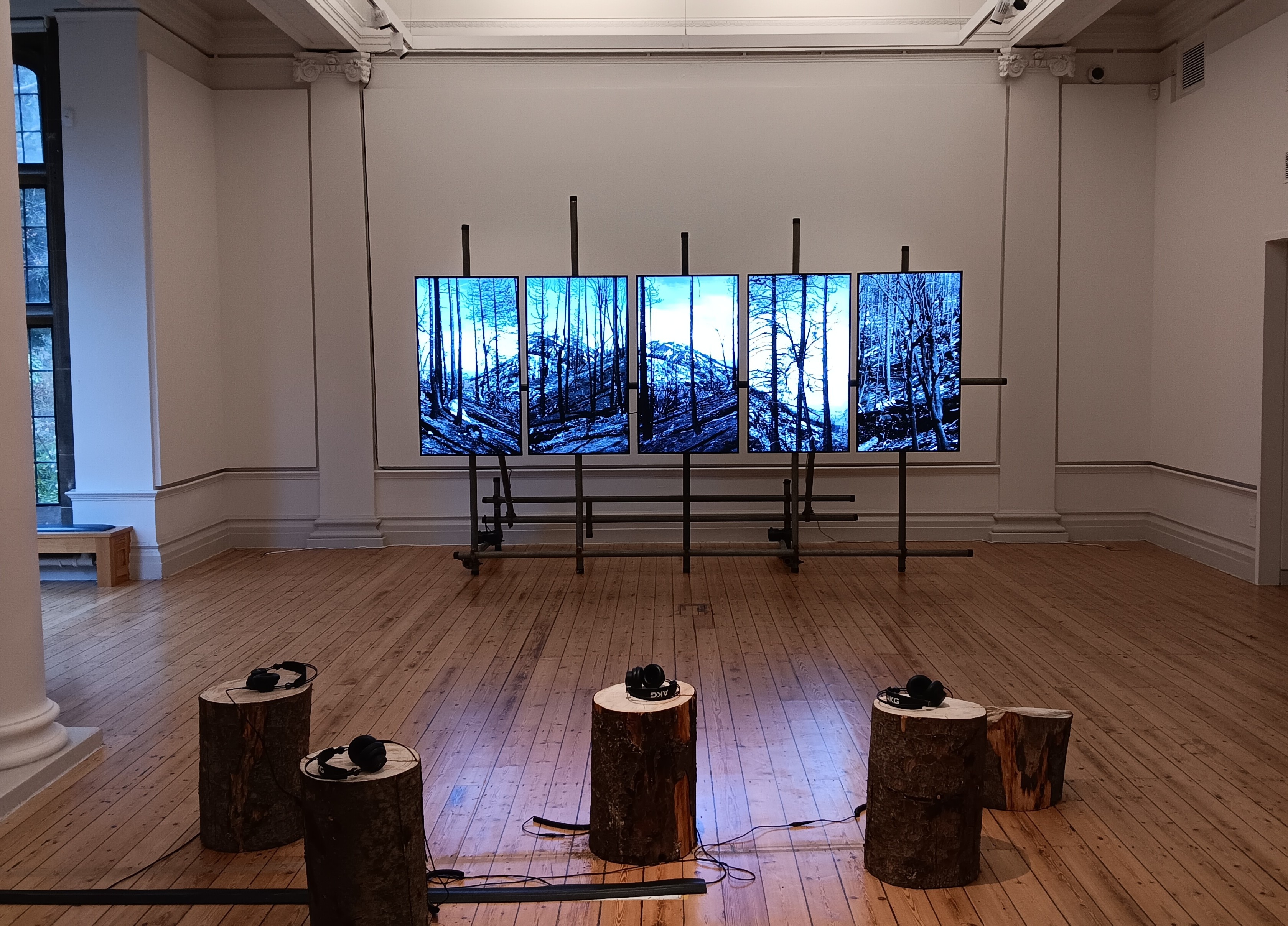
Cull (part of Fire Complex). Video and audio installation. Photo: Dave Pritchard
“It’s past the size of dreaming” declared Cleopatra, in a different story of love[1] – but as efforts to grapple with enormities go, the exhibition reviewed here (and however/wherever it may next ripple onwards) is a gem that may do better than most.
Art addressing concerns about the impacts of industrialised humans goes back centuries, but the ecological and injustice nuances of climate change have only in more recent decades become part of the curatorial mainstream, where they now (thankfully) feature widely.
An historical perspective on this latest exhibition at Newcastle’s Hatton Gallery may be fitting, given the gallery’s celebration of its centenary in 2026[2]. The Hatton maintains a respected position for linking pioneering contemporary art with teaching, academic research, and bringing non-gallery work into an urban art-world context.
Uta Kögelsberger’s solo exhibition Some kind of love: actions and reactions to living on a damaged planet (September 2025 – January 2026) satisfyingly honours all these elements. Based primarily in London and California and working internationally, she is also a Professor at Newcastle University, and her own primarily visual arts practice is grounded in experientially-driven research, multi-disciplinary collaboration and community engagement. Her works have appeared or been acquired for collections in a range of prestigious institutions; and she has received a long list of awards.
The exhibition fills the circuit of spaces in the gallery with four main bodies of work centred on the clear consciousness of a “damaged planet”, but more multivalently hovering over pivot-points between trauma and healing, clarity and complexity, macro and micro, individual and collective. And of course “actions and reactions” – of which more below.
Fire Complex (2020–22) features a five-channel video centrepiece Cull, along with drawings and photographs. It addresses the apparently brutal clear-up aftermath of one of the most devastating recent wildfire episodes in California. This work was honoured by the Royal Academy’s Wollaston Award. The so-called ‘Castle Fire’ in 2020 burned for four months and destroyed vast areas of forest, including up to 14% of the world’s remaining giant sequoia trees – an intrinsically precious biodiversity asset, but ironically also hugely important for sequestering carbon. Equally pertinent was the trauma inflicted on the local community, including Kögelsberger herself, whose home was destroyed.
This personal stake injects an edge in the work, and has ramped up the “care” and “make a difference” agenda she cites increasingly now in her art practice, which is never content to be merely observational and reflective. Her project in this instance included a takeover of advertising billboards in public spaces, and a push for restoration – involving community and federal bodies collaborating to plant thousands of replacement trees, work with a specialist group cloning the most resilient sapling strains, and a bipartisan proposal in the US Congress for new protective legislation.
The screens show a succession of skyscraper-sized redwood remains being toppled to the ground. It is essential to watch this while using the headphones that provide an accompanying soundscape, for the full effect of what feels like combining an elegant drama-laden symphony with meeting your end in a plane crash.
Photographic stills highlight relationships of competition and mutual dependence between trees, some aspects of which are only now unfolding at the leading edge of science. A huge elegiac wall-hanging of charred wood seems to provoke questions about death and re-birth. Nothing here is simple. Everything here is compelling – whether viscerally or intellectually or both.
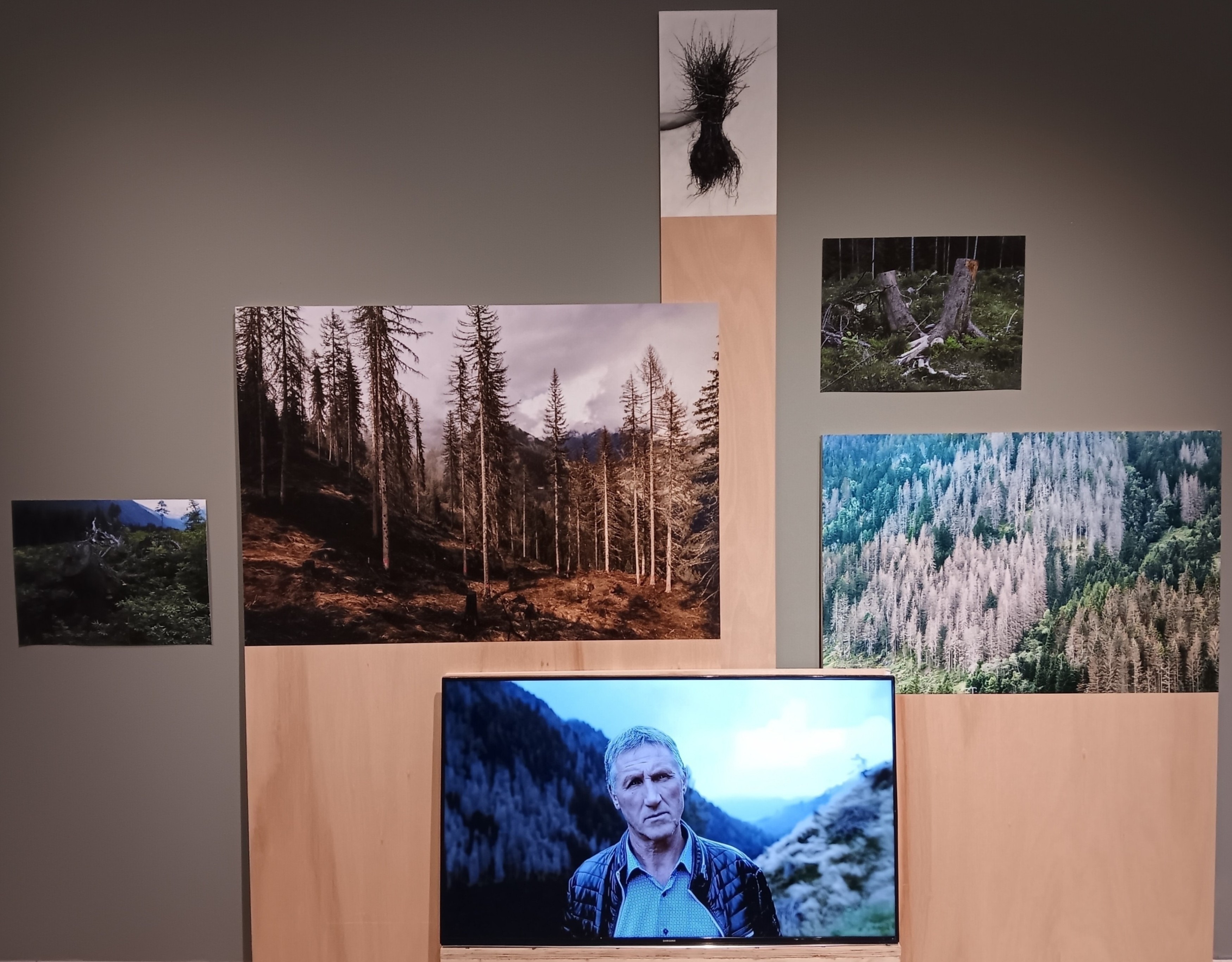
Forest Complex (detail). Video, photography, drawing and sculpture installation. Photo: Dave Pritchard
The contrapuntal assemblage of works in Forest Complex (2023–24) shifts attention to plantation forests in alpine Austria. With a positive role in landslide prevention, employment and the timber economy, the shallow-rooted spruce monocultures are at the same time especially vulnerable to water stress and destruction by storms and insect attack, all exacerbated by climate change.
The artist immersed herself in studying the tangled after-story of one such event. Storm Vaia destroyed 15 million trees across four countries one night in 2018, and lessons learnt were key to shaping responses to further devastation from a spate of summer storms in 2023.
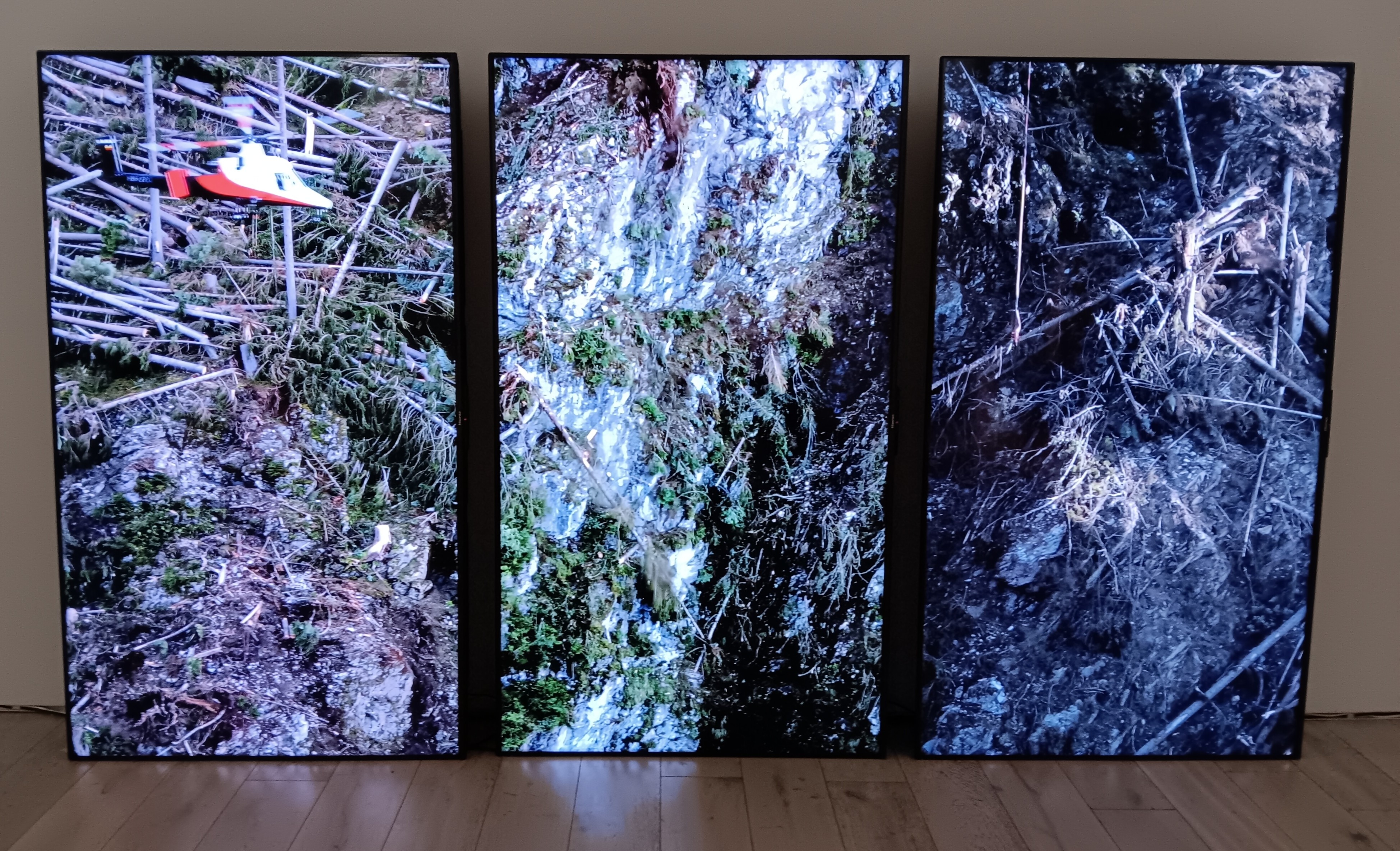
Forest Complex (detail). Photo: Dave Pritchard
Downed trees provide the conditions for a mass irruption of bark beetles which can then devastate the living forest, so rapid removal of the wood is a cleanup priority. Included in Forest Complex is a three-channel video installation that gives vertiginous views of the daunting and dangerous helicopter-assisted process of removing giant storm-wrecked trees from the steep sides of a 145 metre-deep gorge; and includes zoomed-in shots of a single hard-hatted worker balancing ant-like among the timbers.
The accompanying audio (of tree-trunk cataclysms ending with a Bach cello solo) could be an artwork on its own, skilfully avoiding any trite “despair/hope” binaries, but nevertheless evoking those two poles in a subtler way. In other work (with echoes perhaps of Paul Nash’s paintings from World War I), Kögelsberger has portrayed the left-behind stumps and roots, and the beginnings of ground vegetation re-growth – simple images that tie together a complex web of human and natural struggles.
The human dimension is explored further in two other videos. One of these spectates with an almost anthropological eye on the workings of an industrial sawmill, where production has gone into overdrive to deal with the sudden glut of storm-generated raw material needing to be processed. This excess of supply caused a dramatic drop in the price of timber, and with trees on farms being a vital component of local livelihoods, major economic hardships have resulted. Many farmers have abandoned their land to seek employment elsewhere, leading among other things to a shortage of local labour for post-storm clear-up work – which itself, with its huge expense, is a further hit on the economy.
The second video here is a series of silent but emotionally eloquent portraits of individuals affected by the various links in this chain of consequences, the anthropogenic causes of which entwine both climate change and risk-laden extractive land uses. (It would be intriguing to see this juxtaposed with the “similar but different” idea behind In a Strange Place, the project by Canadian artist duo Mia + Eric, which was shown in the UK as part of the Gateshead International Festival of Theatre in 2025).
Other works by the artist conjure the sonic world that trees inhabit, drawing on emerging research that reveals ultrasounds emitted by plants that are suffering insect attack, and suggests that exposure to music can bolster plant immune systems and accelerate growth. With the flowering of ecological arts practices in recent decades, it seems increasingly frequent for these areas of new understanding to be developed in parallel by scientists and by artists, including (for example) Alex Metcalf, Reiko Goto and Tim Collins, as well as Kögelsberger herself.
In both of the “Complex” rooms, deep thought has gone into the artist’s specified staging of the installations; ranging from the scaffolded mounts of screens, to the upward look required for the larger drawings, and the detail of wood-related backgrounds that feature more or less obviously in various places. In particular, the siting of some collaged assemblages of framed works on the floor and leaning against the wall, instead of being conventionally nailed in place higher up, is a deliberate encapsulation of an idea of instability that threads through the stories of flux, fragility and indeterminacy in the human and ecological systems portrayed in the exhibition.
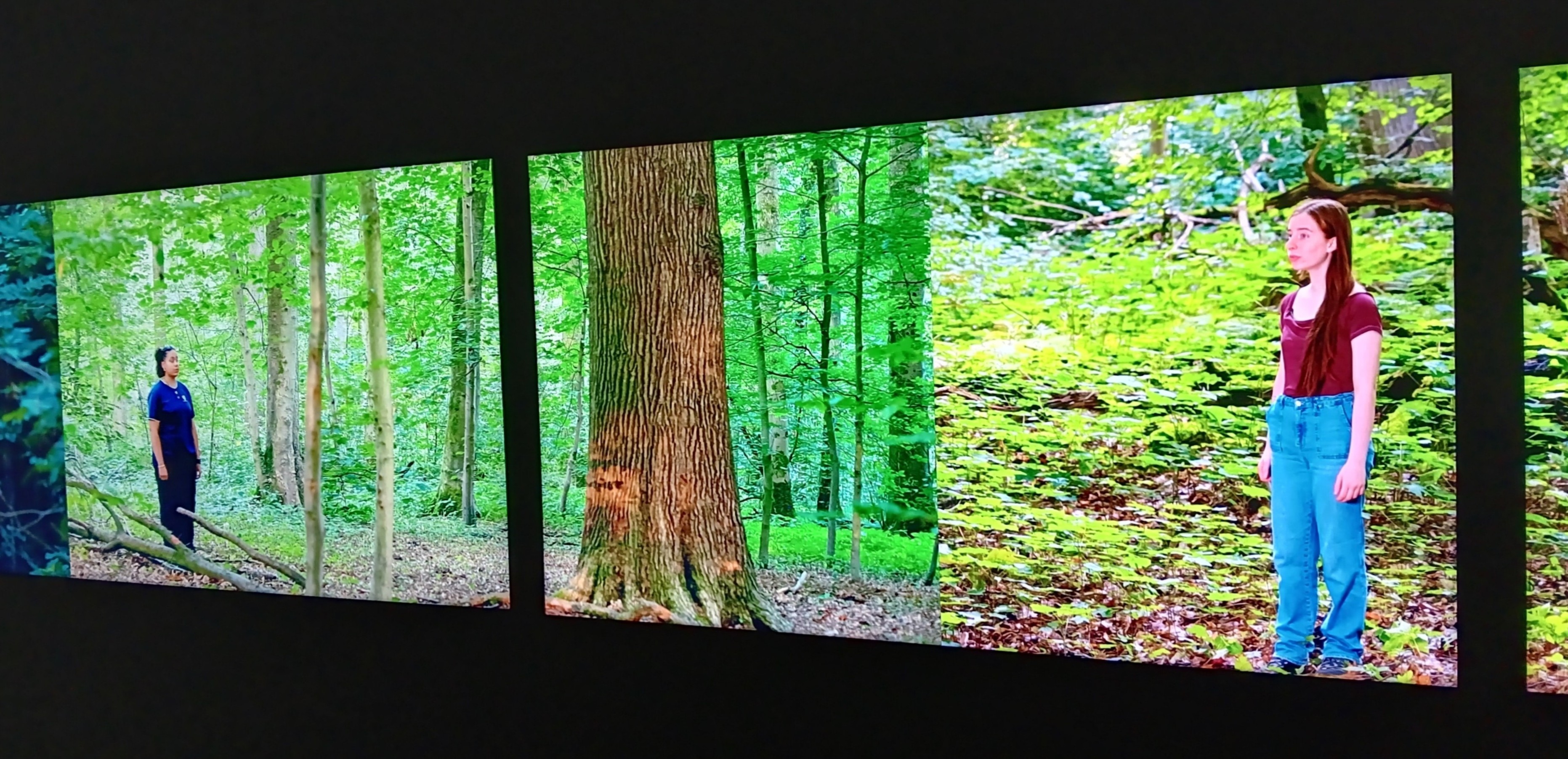
Forest Choir (detail). Five screen video installation. Photo: Dave Pritchard
One other whole room is given over to the wall-to-wall video installation Forest Choir (2025), which was developed in collaboration with the Brussels Opera Youth Choir and was created specifically for this exhibition. Choir members stand solemnly in mid-forest, alternating their slow and plaintive voices as they sing to the trees. There is a sense of pain and willed healing, tragedy and belief-based care; unarguably demonstrating “some kind of love”.
Forest Choir was re-staged with local participants in Newcastle’s Jesmond Dene in November 2025, as part of the nationwide “Remember Nature” day of action inspired by Gustav Metzger’s original 2015 mobilisation of arts-led responses to the extinction crisis.
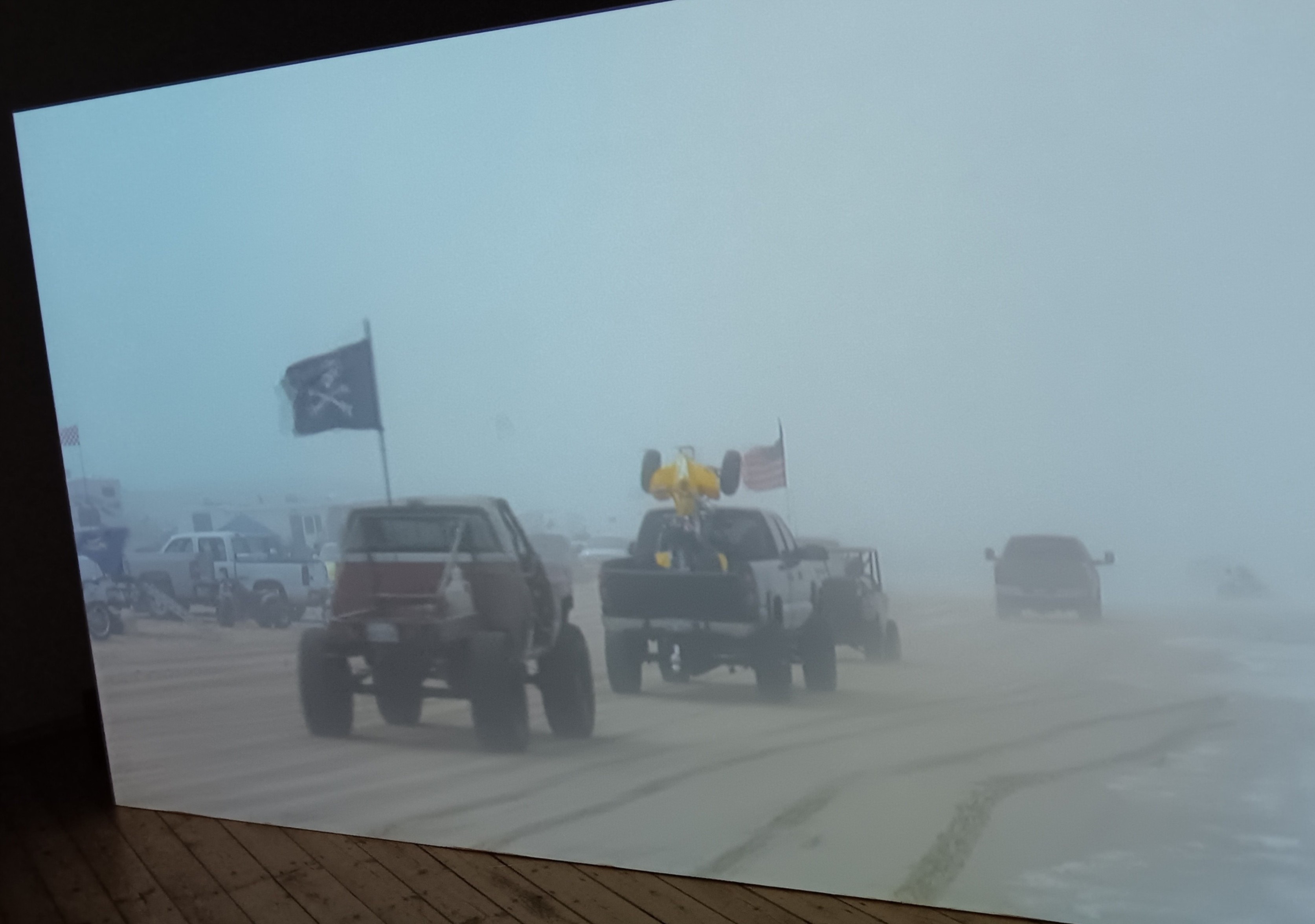
Off Road (detail). Video installation. Photo: Dave Pritchard
A further room houses the video installation Off Road (2008-14), an earlier work in which we watch a mysterious criss-crossing of trucks, jeeps, quad-bikes and mobile homes in the ethereal fog of Grover Beach in California. This is the weekend activity in a State Vehicular Recreation Area, where the sole purpose of those arriving is to drive through the sand dunes for fun; but where there are deep concerns for impacts on an adjacent nature reserve.
This film, now acquired by the Los Angeles County Museum of Art, is part of a trilogy of works in which Kögelsberger has confronted contested ideas about freedom, land, community, and economic and ecological fragility in the American west. The unsettling aftertaste of this piece is somehow more lasting because of its understated presentation, and its political resonances are surely even stronger today than could be imagined at the time.
It is significant that this exhibition as a whole is not laid out as a chronological survey, and (unlike some climate change narratives) it avoids suggesting linear relationships between cause and effect, or binary equations of call and response. As the “Fire” and “Forest” titles emphasise, the whole thing is more “complex” than this. Among species, global warming produces winners and losers. Among humans, those suffering are mostly not the ones who have driven the problem. The costs of disaster response and cleanup nonsensically far outweigh what it would have cost to invest in sensible prevention (as with other realms of life like health and crime, showing how poorly educated our societies are in general about issues of risk). Dead wood is great for ecosystem biodiversity, and bark beetles are native to Austria; but human-created monocultures and climate change have made both into a crisis. Christopher Stone’s seminal 1972 book “Should trees have standing?” fuelled an expansion of the “rights of nature” movement, but the moral dilemmas occasioned in specific instances like the ones in this exhibition have not become any easier to unpick…
Uta Kögelsberger has fearlessly and compassionately questioned what humanity’s sociocultural and political systems are supposed to do about these dilemmas, paradoxes, interconnections, contradictions and failures of governance. Her Hatton exhibition is “some kind of” manifesto for what value art might be positioned to add in response, with its repertoire of specialist methodologies for social engagement and creatively forensic investigation, as well as the capacity to create an affecting experience through the carefully judged combination of elements engaging our minds and our senses, in this case out of an event very remote from the viewer.
She describes an impulse to collaborate across stakeholder categories and to “make a difference”. This was hardened somewhat by the personal impact of the Castle Fire; but this is not really about didacticism, because (as fellow academic Olga Smith has observed) the impulse “comes from a place of vulnerability”. There are potential tensions here, with the risks of art being instrumentalised for advocacy agendas, at the expense of recognising the more fundamental importance it may have in its own right for “re-framing” our most acute social and environmental problems and options for response. But with the story here stretching beyond galleries to practical community replanting initiatives, legislation and scientific research, these hazards seem to have been successfully navigated.
All the lens-based image work and drawings here are of a high quality, both technically and aesthetically; and the Hatton Gallery has matched this by enabling a sensitive and skilful installation. It might be interesting to consider what an exhibition of this kind would address in relation to the biodiversity crisis as well as the climate one; and perhaps that may be an avenue for future thought.
Turning back to the exhibition title, perhaps the “actions” mentioned first are those that have (globally) led to our whole atmospheric carbon imbalance. The artworks, on the other hand, mainly have a starting-point of the “reactions” of human decisions about how to respond, intelligently, to the resultant effects – with researched strategies about possible resilience, the power of empathy and care, and then perhaps a realm of “new actions” that offer us some cause for redemptive optimism.
We need scholar-artists like Uta Kögelsberger to show us the way forward with this. Credit to her and to the Hatton Gallery for inviting the opportunity to do so. We as viewers await her next project, and the gallery’s next hundred years of inventiveness!
Some Kind of Love: Actions and Reactions to Living on a Damaged Planet, Hatton Gallery, King’s Road, Newcastle University, Newcastle upon Tyne, NE1 7RU – https://www.northeastmuseums.org.uk/hatton
20 September 2025 – 24 January 2026. Monday – Saturday, 10am – 5pm (admission free).
More information about the exhibition: https://www.northeastmuseums.org.uk/hatton/whats-on/some-kind-of-love-actions-and-reactions-to-living-on-a-damaged-planet .
Artist’s website: https://utakogelsberger.uk/
Download this review:
Dave Pritchard is an independent consultant in environment, culture, heritage and the arts; based in the UK and working internationally.
[1] William Shakespeare – Antony and Cleopatra, Act 5, scene 2.
[2] Although this marks 100 years of bearing Richard Hatton’s name, there has been a gallery here in the heart of what is now Newcastle University’s city centre campus since 1912. It is now run as a partnership between North East Museums and the University.
 ecoartscotland.net
Leave a comment