
…meta moments don’t just add a bit of humour, they also urge us to think more deeply about the place of art in exploring human understandings of deforestation. Each myth (or mythical extract) that is shared in STUMPED shines a different light on this understanding, often highlighting human connections historically with individual tree species.
It’s the early evening of the first Friday of the 2024 Edinburgh Festival and it feels like the city is still limbering up. At the Scottish Storytelling Centre, I join an audience sitting quietly on narrow wooden benches, waiting to be invited downstairs to the theatre for the opening night of STUMPED, a new opera exploring deforestation ‘through scenes from five ancient stories’. Although in the programme it is titled a ‘miniature opera’, STUMPED is huge in its aspirations and scope. STUMPED explores the connections between human behaviours and deforestation—or in some cases, tree felling on a smaller scale – through five myths spanning thousands of years.
The show opens with two characters, the aptly named myth_moth and historymystery, played by mezzo-sopranos Shuna Sendall and Catherine Backhouse, sitting at tables in front of their computers, apparently in a noughties style internet chat room. The musical ensemble – an unusual combination of two string (violin and cello) and two brass (trombone and trumpet) players, sit to the side, in a semi-circle facing the audience. Conductor Tom Butler sits facing them, his back to the audience – like the magician-moderator of this imaginary chat room. A small projection screen is angled between the characters and the ensemble, and surtitles inform us that myth_moth is writing:
“So, I’m stumped. Can I ask you about deforestation, d’you think?”
she asks, and myth_moth and historymystery’s exploration of mythology and deforestation begins.
The internet chat room is the frame through which the opera unfolds and the five different myths are told. We are not invited into myth_moth and historymystery’s everyday lives. Their connection would appear to be based on their shared love of history, truth-seeking and storytelling. Myth_moth, played by singer Shuna Sendall and historymystery, played by Catherine Backhouse, ask questions and tell each other stories in this internet chat room, inhabiting and embellishing the stories together, fully immersing themselves in the tales, singing them in to life, and drawing conclusions from them.
The shifts between the internet chat room and the various myths that myth_moth and historymystery narrate are beautifully composed and cleverly choreographed. Often, the last word said in the internet chat room becomes the first word of the myth that is narrated in song (and the other way round) – the word being repeated, elongated and layered, marking the transition from one world, time and place to another. Sometimes the music supports or follows the characters in their explorations, sometimes it seems to lead them. If Tom Butler is like a magician conducting between the multiple worlds, Emma Lloyd on the violin is the high priestess, supporting the realisation of the deeper truths, anxieties and human frailties that the myths reveal, enabling them to be fully felt, and faced. At times the violin and voices riff off each other, wavering and shuddering in prolonged moments of horror, pain or realisation—before the cello brings attention back to the heart, and the brass keeps the enquiry going.
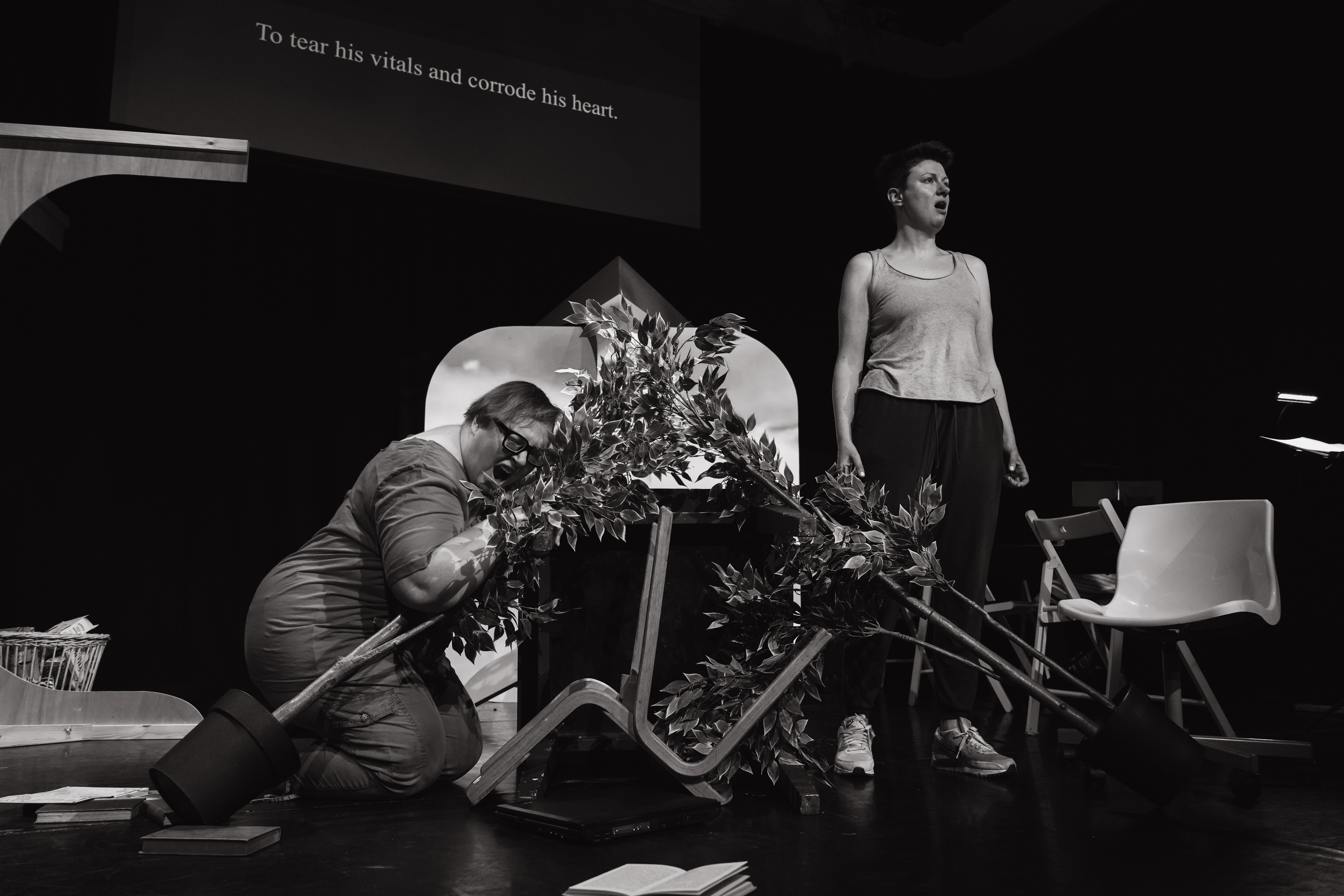
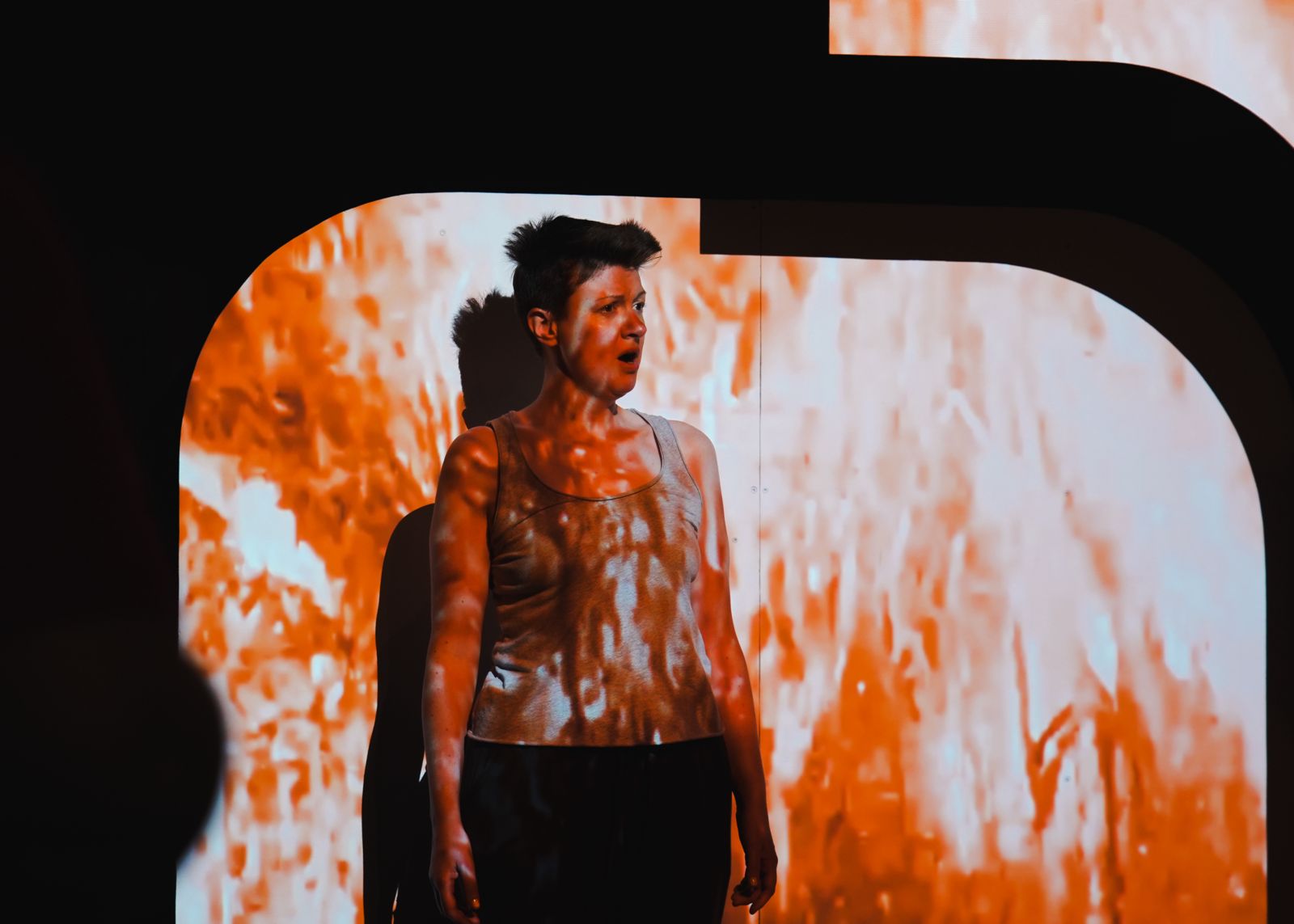
Hunter Muir’s inspired and sensitive set design enables the elements and artforms to work together in ever-shifting configurations, to create the multiple different worlds, although it does feel slightly confined on the intimate stage of the Storytelling Centre. Throughout the piece, archival footage of deforestation in action, of forest fires—and sometimes of living trees or new growth emerging—is projected onto the screen between the singers and the musicians. The images, which relate to the myths being shared, and to myth_moth and historymystery’s musings, flow at times over the singers bodies, heightening the sense of their characters’ immersion in a virtual world, and bringing attention to the fact that the mistakes of the past are all too often felt or repeated in the present. At other times, the singers’ bodies cast dark shadows on the screen, reminding us perhaps of the slipperiness between what is seen and what is obscured, between mythology and truth. This is a central question in STUMPED, that is introduced as myth_moth’s reason for entering the chatroom. She has discovered an article called ‘the Myth of Deforestation’ on the website of an organisation called the ‘Foundation for Economic Education’ and wants to find out whether their denial of the extent and impact of contemporary deforestation has any truth to it. In the transition between the second and third stories (taken from the Tale of Two Brothers, Egypt, 1200 BC and the Mahabharata, India 300BC-300AD), myth_moth surmises that there’s kind of a rich history of avoiding confronting deforestation. As the forest of Khandava (in the extract from the Mahabharata) is ‘consumed’ by fire, and images of forest fires are projected on the screen, myth_moth adds that
it’s confusing cos if you google ‘Deforestation Myths’ thousands of articles come up and there’s like no way to tell what side of the argument they’re on or how reliable they are. Agh, but the same goes for this forum I suppose. So is it a fake? And like what’s the point in that?
These meta moments don’t just add a bit of humour, they also urge us to think more deeply about the place of art in exploring human understandings of deforestation. Each myth (or mythical extract) that is shared in STUMPED shines a different light on this understanding, often highlighting human connections historically with individual tree species. Cedar is the focus of the first story from the Epic of Gilgamesh, Acacia of the second from the Tale of Two Brothers and Oak of the fourth story from Metamorphoses, in which the exploration of the dangers of human greed (and unchecked consumption) reaches its climax. In the fifth and final story, the suffering ash tree (from the Poetic Edda) is the pertinent focus. This beautifully lit scene brings the past splendour and current precarity of ash trees in forests across the world vividly and viscerally into presence.
historymystery and myth_moth’s searches appear to lead them to conclude that mass deforestation has been linked historically with the fall of some cities and civilisations, and the exploitation of others. historymystery wonders ultimately whether the ancient myths around deforestation and felling, with the terrible consequences that can ensue, are like a record […], passed down for the people […]… or a warning, and the opera ends with her issuing a heartfelt plea for new stories, powerful enough to counter the global economic narratives that are currently defending mass and global deforestation:
the ‘Foundation for Economic Education’s of this world are telling tales, and we’re not going to counter them just by giving the facts, we need stories of our own, legends, myths.
Following each performance of STUMPED, an invited guest comes on to the stage to share a story of their own, responding perhaps to this plea. On the opening night the guest was Amy Clarkson from the Applecross Community Woodland. Amy brought the audience’s attention back to Scotland, touching briefly on the historical deforestation of the North West of Scotland, and the complex relationship between land ownership and forestry in the Highlands, before telling us about the Applecross Community Woodland. One of the things the Applecross collective is doing is transforming a former Sitka spruce plantation into a mixed species native woodland, something that is involving felling as well as replanting. Amy reminds the audience that any of us can get together to create a community woodland, in urban as well as rural areas, before we climb back up the stairs of what was once John Knox’s house, to the conspicuously tree-less Royal Mile outside.
A Made in Scotland production, with support from the Hope Scott Trust, STUMPED is the only opera in the 2024 Made in Scotland programme, and is composer and writer Lewis Coenon-Rowe’s first self-consciously ‘environmental’ opera. Lewis Coenen-Rowe started writing the opera during the COVID pandemic, and first developed it with a creative team in a Research and Development phase in 2023, in between his other work commitments as culture/SHIFT manager with Creative Carbon Scotland. Most of the original creative team have reconvened for the run at the Scottish Storytelling Centre, although one of the two singers, Catherine Backhouse, and the Director, Edie Bailey, are new additions.
STUMPED is running at the Scottish Storytelling Centre until the 13th August.
Rachel Clive is a writer, theatre practitioner, curator and practice-based researcher who has worked with and for a number of arts organisations across Scotland and the rest of the UK, including the National Theatre of Scotland, National Youth Theatre, Tramway, the Citizens’ Theatre, Lapidus Scotland, Playwrights’ Studio Scotland, the Scottish Neurodiverse Performance Network, the Scottish Mental Health Arts and Film Festival and the Royal Conservatoire of Scotland.
She has worked professionally in a wide variety of social contexts, including criminal justice, health and social care, education (primary, secondary, further, community and higher education as well as TiE – theatre in education), community, festival, interfaith, environmental, horticultural and heritage contexts.
Rachel recently co-wrote and directed Three Words for Forest, a verbatim play that draws on 30 interviews with forest practitioners, scientists and policy-makers to explore the challenges, hopes and uncertainties of living and working with trees and forests in a time of climate crisis. Three Words for Forest premiered during the Treescapes24 Conference in Glasgow and is currently being workshopped across Scotland and the rest of the UK.
 ecoartscotland.net
Leave a comment